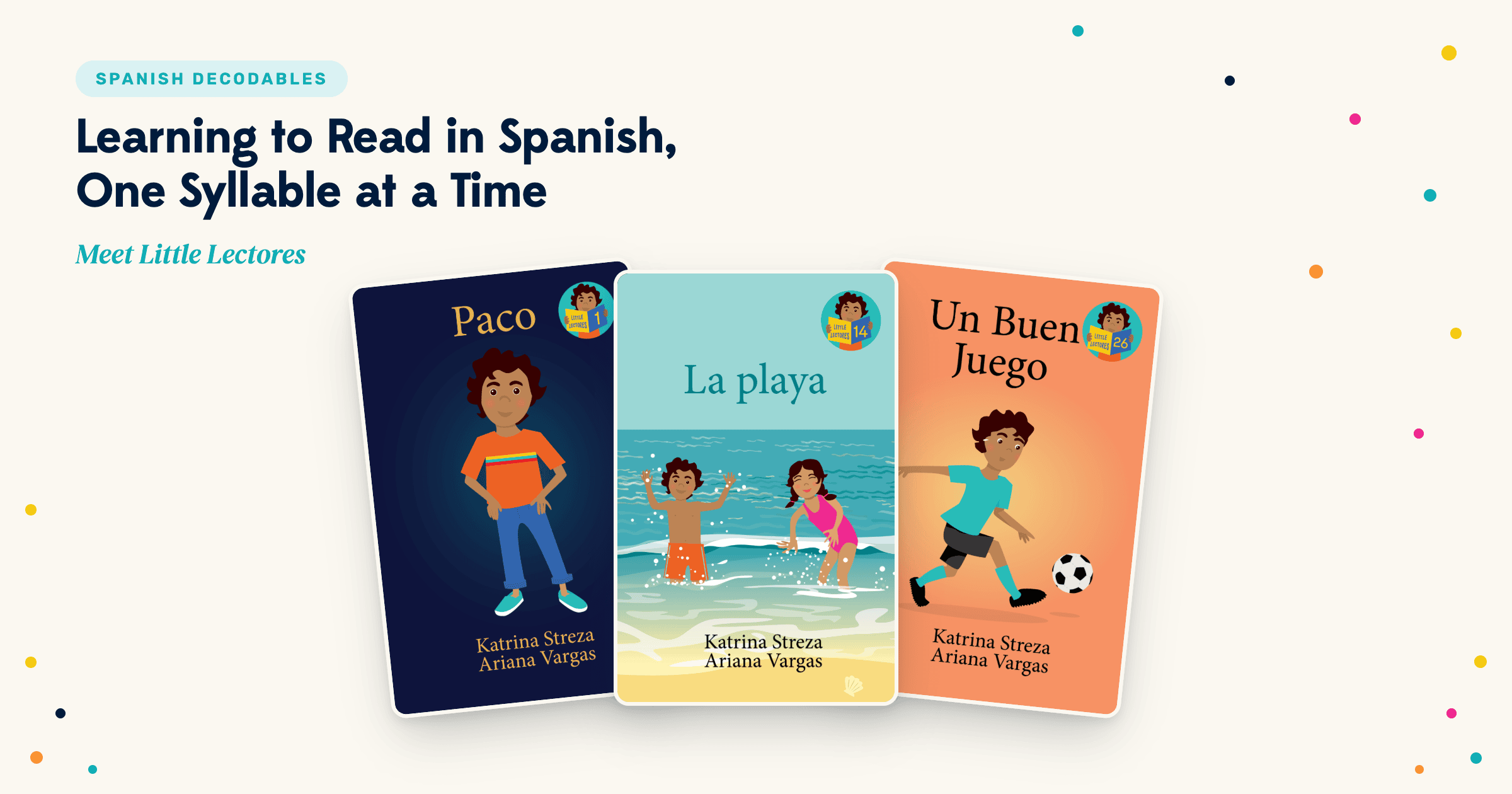
 For a lot of kids, Spanish is the language of home — the one spoken at the dinner table, at abuela's house, in the car on the way to school. For other kids, it's a language they're just discovering, one they're excited to make their own. Either way, learning to read in Spanish takes a different set of tools than learning to read in English, and most beginning readers on the shelf weren't built with that difference in mind. Little Lectores, Xist Publishing's new 32-book series of Spanish decodable readers, was.
Written in authentic Spanish by Katrina Streza and Ariana Vargas and illustrated by Brenda Ponnay, Little Lectores follows Paco, his dog Coco, and his best friend and neighbor Zita through the everyday moments of a kid's life — getting dressed, going to the store, playing at the park, helping in the kitchen — while systematically building the exact skills a new reader needs to sound out Spanish on their own.
Built around how Spanish actually works
English phonics programs lean on rules with a lot of exceptions. Spanish doesn't work that way. Spanish is a syllabic language, built by pairing consonants with vowels into syllables that are pronounced the same way every time. The syllable "co," for example, sounds identical whether a child is reading Paco, Coco, or come — no guessing required.
Little Lectores takes full advantage of that consistency. The series starts with simple one-to-one letter sounds and repetitive CV (consonant-vowel) syllables in Book 1, then layers on complexity gradually: two consecutive consonants and vowel syllable breaks by Book 9, diphthongs by Book 16, three consecutive consonants by Book 22, and full paragraphs for fluency by Book 27. High-frequency sight words are introduced alongside the decodable text at every stage, so kids are building real reading skills — not just memorizing sounds — from the very first page.
Every title is mapped to Common Core Reading Standards for Foundational Skills, from kindergarten phonemic awareness through first-grade fluency, so the series slots neatly into a classroom scope and sequence or a home reading routine. For the full breakdown — book by book, phoneme by phoneme, sight word by sight word — download the Little Lectores Scope & Sequence Guide →.
A reading buddy for every kind of learner
What makes Little Lectores especially useful is how many different readers it's built to serve.
For kids who already speak Spanish at home, these books offer something that's genuinely hard to find: decodable readers written in authentic Spanish, not translated from English. Co-author Ariana Vargas, who grew up in Oaxaca, Mexico, made a point of choosing simple, natural sentence structures that hold up across Latin American and European Spanish dialects, so the language feels right no matter where a family's Spanish comes from.
For kids acquiring Spanish as a new language — in a dual-language classroom, an immersion program, or simply a household that wants to raise bilingual readers — the same systematic, syllable-by-syllable approach that supports native speakers also gives new learners a gentle, confidence-building on-ramp. Because each book pegs its Spanish high-frequency words to the 100 most common English sight words (and pairs with the companion Little Readers series in English), teachers and parents can build fluency and comprehension in both languages side by side.
That flexibility is exactly why Little Lectores works equally well for Spanish-speaking students learning to read in their native language, for Spanish immersion classrooms, and for ELL and bilingual coordinators looking for material that respects where their students are starting from.
A tool parents and teachers can actually use
Reading instruction works best when the adults in the room understand the "why" behind it, not just the "what." That's the idea behind the Little Lectores Phonemic Awareness Chart — a simple, printable reference of the CV syllable blends used throughout the series (pa, ta, ga, me, te, mi, ni, co, so, and on through diphthong blends like bue, que, and cue). Parents and teachers can use it to chant syllables with new readers, play matching games, or simply preview the sounds a child is about to meet in their next book. Get the Phonemic Awareness Chart →
The people behind Paco, Coco, and Zita
Little Lectores comes from a team that has spent years thinking about how kids actually learn to read. Katrina Streza, MA, developed the series' scope and sequence and 100-word sight word list after years working with elementary students and, more recently, teaching high school English and AP Psychology — including building curriculum to address pandemic-era learning loss. Ariana Vargas, who studied Spanish and bilingual education at UC Irvine and now works as a bilingual educator and community coordinator, brought the authentic voice and cultural grounding that make the stories feel real. Illustrator Brenda Ponnay, whose work has been read more than 10 million times on Epic and featured on Good Morning America, gives Paco, Coco, and Zita the warmth and humor that make kids want to turn the page.
Whether Spanish is the language your reader has spoken since day one or one they're just starting to explore, Little Lectores meets them exactly where they are — one syllable, one sight word, and one Paco-and-Coco adventure at a time.