
 Tell a kid it's time to read a poem and you might get a groan. Tell that same kid "hey batter batter, swing ___ ___!" and watch them finish the line without missing a beat. That's the secret hiding in plain sight: kids are surrounded by poetry every day. They just know it as something else — a song stuck in their head, a jingle they can't shake, a cheer they've shouted from the dugout a hundred times.
Rhyme, rhythm, repetition, and clever wordplay are the building blocks of poetry, and they show up constantly outside the poetry unit. The trick to getting kids excited about poems isn't necessarily starting with a page in an anthology — it's showing them the poems they're already carrying around in their heads.
What actually makes something a "hidden poem"
Before hunting for examples, it helps to know what to listen for. A hidden poem usually has one or more of these:
Rhyme — words that echo each other at the ends of lines. Rhythm and meter — a beat you can clap or stomp to. Repetition — a line or phrase that returns, building momentum (this is where refrains and choruses come from). Sound play — alliteration, wordplay, or even spelled-out words used for rhythm and suspense.
Once kids know these four ingredients, they can start spotting poetry everywhere — and that's the real goal. Not memorizing definitions, but training an ear.
Start with the songs they already sing
Pop songs are poems with a backing track. Pick a favorite song and print the lyrics without the music. Ask: where does it rhyme? Where does the same line come back around? Where does the rhythm speed up or slow down? Kids who'd never sit still for a Shel Silverstein poem will happily pick apart a chorus they've sung a thousand times — and once they see the rhyme scheme on the page, they've done real poetry analysis without realizing it.
Then move to the jingles that won't leave their head
Commercial jingles and ad slogans are some of the tightest, most deliberately crafted little poems out there — someone got paid to make sure a phrase would stick. "Have it your way." "I'm lovin' it." A cereal box mascot's little rhyme. Ask kids to bring in a jingle or slogan they can't forget and figure out why it works. Usually the answer is the same short list: rhyme, rhythm, repetition. Ads are a great bridge because they're short, funny, and completely unintimidating — perfect for kids who think poems have to be long or serious.
And then, the dugout: baseball cheers as poetry
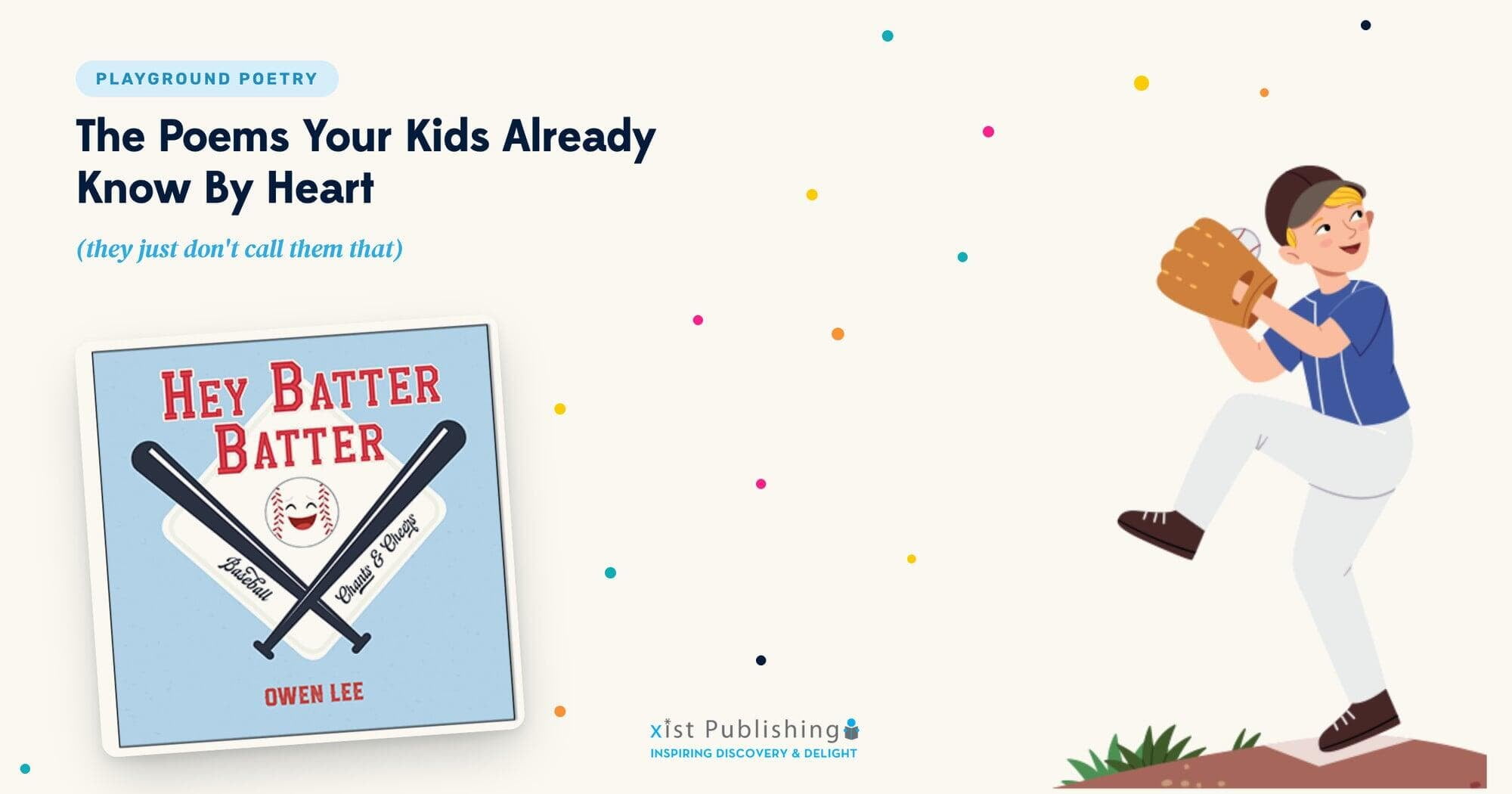
This is where things get really fun — and where our new favorite mentor text comes in: Hey, Batter Batter {Baseball Chants and Cheers} by young author and baseball player Owen Lee, available from Xist Publishing.
Baseball dugouts are basically oral poetry factories. Cheers get passed from player to player, season to season, refined over and over until only the catchiest version survives — which is exactly how folk poetry has always worked. Flip through the book and the poetic devices are everywhere:
Rhyme carries the momentum in cheers like "Battle, battle, rip it to Seattle. If you get lucky, rip to Kentucky. If you can, rip to Japan." Repetition builds the chant in "Ball four, base hit! Ball four, base hit! Ball four, base hit!" Spelled-out words create suspense and rhythm in cheers like "We need a single, just a little single. S-I-N-G-L-E!" And plain old silliness and internal rhyme show up in favorites like "We want a pitcher, not a belly itcher!" and "Hey pitcher, look at me, I'm a monkey in a tree! Ooo ah! Ooo ah!"
Read a few of these out loud with kids and clap along, and they'll feel the meter in their bodies before they ever hear the word "meter." Then ask the poetry questions: What rhymes? What repeats? Why does it feel good to shout? Kids who've stood in a dugout yelling "hits on three!" already have an intuitive grasp of rhythm and repetition — this just gives them the vocabulary to talk about it.
Try it as a writing activity, not just a reading one
Once kids can identify rhyme, rhythm, and repetition in a cheer, jingle, or song, the natural next step is writing their own. A few easy on-ramps:
Write a cheer for a favorite team or player, using a cheer from the book as a template and just swapping in new names and details. Turn a jingle into a cheer, or a cheer into a jingle — same tools, new context. Write a "hidden poem" scavenger hunt list and have kids collect one example each of a song hook, an ad slogan, and a cheer or chant, then present their favorite to the group and explain what makes it work.
This kind of low-stakes, high-familiarity writing is a great warm-up before tackling more traditional poetic forms — by the time kids get to haiku or free verse, they'll already know rhyme and rhythm aren't scary; they're just baseball.
About the book
Hey, Batter Batter {Baseball Chants and Cheers} Written by Owen Lee
A joyful collection of the chants, cheers, and dugout wisdom that make baseball season what it is — from classic call-and-response cheers to sportsmanship shout-outs to a few good-natured jabs at the ump. It's a natural fit for baseball families, team read-alouds before the season starts, or a poetry unit looking for an example kids will recognize instantly.
About the author
Owen Lee has played baseball since he could hold a bat in his hands. Written when he was a 12u player in Houston, Texas, Owen has always loved cheering on his teammates from the field — and he brought that same dugout energy to the page. A left-handed pitcher who also plays first base, Owen loves reading funny books about real-life situations, hanging out with his friends, and, of course, playing baseball. Hey, Batter Batter is his first book, and it's about as close as you can get to hearing poetry straight from the source — a kid who's actually been out there shouting it.
Poetry doesn't have to start on a page kids don't recognize. It can start at the plate, on the radio, or in a jingle from a commercial they've seen a hundred times. Once they know how to listen for it, they'll never run out of poems to find.